Relation Between APOE4 Gene and Dementia
Tanner Smith

*The Effects of Alzheimer's on the Brain
Introduction
Approximately 25% of individuals possess the APOE4 gene. This gene puts the individuals who have it at risk by increasing their chances of developing Alzheimer’s disease, the most common form of dementia, by causing the onset of this disease to occur earlier. Dementia was officially recognized as a diagnosis in 1797 by French Doctor Philippe Pinel. Alzheimer’s affects approximately 6.5 million Americans over the age of 65, as of 2022 (Alzeihmer’s Facts and Figures). Dementia is a tragic disease that affects not only the individuals with the disease, but also those who love and care for them; it is because of this tragedy that the government should provide more funding for the Alzheimer’s Association, so that they can discover more information on why the APOE4 link leads to Dementia, find ways to stop the gene, and find more ways to delay and prevent the onset of dementia.
History of Dementia
Dementia was noted as a medical condition in the eighteenth century, but the word dementia itself has been used since ancient times and “...derives from the Latin root demens, which means being out of one's mind (Assal).” Although dementia was not noted as an illness until the eighteenth century, “the history of dementia is probably as old as mankind, at least since lifespan reached the age of 60 years of age (Sibat).” The first documented use of the term dementia was written in a book entitled Hua Tou Shen Yi Mi Zhuan, by Hua Tuo. This book was written over 2000 years ago between 140-208 AD. This book was written in ancient China, and the author states that one of the causes of dementia is “the insufficiency of flowing energy (Sibat).” The findings in this book authenticate that ancient Chinese medical experts studied dementia. Aristotle and Plato, Greek Philosophers, both believed that losing one's mental capacity was an inevitable fate that comes with old age. In a research article on the history of dementia the author states that, “The Greek statesman and poet Solon established that if a male people’s loss his capacity for judgment due to old age then terms of man’s will might be invalidated, this happened in 550 BC and the Chinese authors considered the medical term of dementia related to ‘foolish old person’(Sibat).” Cicero, a Roman Philosopher in the Roman Empire, believed that aging only affects men who are weak and that men who are mentally active can not get dementia. Cicero stated, “ [a]s I give thought to the matter, I find four causes for the apparent misery of old age; first, it withdraws us from active accomplishments; second, it renders the body less powerful; third, it deprives us of almost all forms of enjoyment; fourth, it stands not far from death.” This quote shows that even in the Roman Empire people were aware of the relationship between the loss of several capabilities and old age. Roger Bacon, in the thirteenth century, stated that dementia was a consequence for original sin and that the brain was the center of all memories. Before dementia was given as a definitive diagnosis, in the eighteenth and nineteenth centuries, “the pathological process of ‘brain congestion’ was the most common diagnosis performed by the medical doctors in several conditions ranging from stroke to anxiety” (Sibat). Over the years researchers have learned how to differentiate between schizophrenia, dementia, and many other mental illnesses from one another. “In [the] 1970s, dementia was delineated from normal aging, and the present concept of dementia was established in Japan (Sibat).” One of the greatest pushes towards dementia research began when United States President Ronald Reagan was diagnosed with Alzheimer’s Disease in 1994. Since then various types of dementia have been identified, and we are now able to diagnose the disease before it even begins; however, we still do not know how to prevent it and how to stop it from progressing.
 |
| *Roman Philosopher Cicero |
History of the APOE4 Gene
In 1993 the Duke University Alzheimer’s Disease Research Center group discovered the connection between the APOE4 gene and Alzheimer’s. In this study they also discovered that there was a genetic link in chromosome 19q13 that tied to Alzheimer’s; this revelation helped them make the connection between Alzheimer’s and the APOE4 gene. “The flash of recognition was the knowledge that APOE was one of the first genes localized to chromosome 19 in the mid-1980's (Roses).” From this study three papers were published, and because of the research, “it was possible to clearly demonstrate that the APOE isoforms were associated with differing ages of onset, but the course of illness following diagnosis was related more to age than APOE genotype. The earliest submitted paper reported the familial association and amyloid-beta binding. The second reported the association with common sporadic late-onset, [not-known to be familial] AD patients. The third reported that APOE4 carriers had earlier rates of onset of clinical disease than APOE2 or APOE3 carriers (Roses).”
Dementia and Why It Is Important
One of the best definitions for dementia is one stated in the article “What is dementia?”. The author defines dementia as “an umbrella term used to describe a range of neurological conditions affecting the brain that get worse over time. It is the loss of the ability to think, remember, and reason to levels that affect daily life and activities (“What is dementia?”). Dementia itself is not a disease, but it is caused by a disease, such as Alzheimer’s. When neurons in the brain quit working correctly due to drastic alterations, it leads to dementia (“What is dementia?”). Some of these drastic alterations include: stroke, concussion, PTSD, etc. Dementia, specifically Alzheimers, impacts many individuals and we, as a society, need to find ways to combat this disease. Research is being done, but their focus is more on ways to detect Dementia early and not on ways to combat it and ways around the APOE4 gene. If researchers can find a way to eliminate the APOE4 gene or to deactivate it, then it could prevent one of the biggest causes of dementia.
 |
*Alzheimer's Brain vs. Healthy Brain |
There are other causes of dementia, such as: Alzheimer’s, HIV, Parkison’s disease, brain trauma, Huntington’s disease, etc (Ellison). Although there are many causes of dementia, the most prevalent of all of these is Alzheimer’s. In a research article titled “Stroke and Vascular Dementia and Alzheimer’s Disease - Molecular Links”, the author states that, “[Alzheimer’s] accounts for more than 80% of dementia cases worldwide in people older than 65 (Vijayan).” In another research article, the author found that the most substantial risk factor gene correlated to Alzheimer’s is the APOE4 gene (Bryant). The APOE4 gene has been found to speed up the onset of dementia and to make it progress more quickly by causing neurodegeneration, which is the systematic destruction of the nervous system (Koriath). In one study, researchers tested mice who had frontotemporal dementia, and they found that dementia in the mice with the APOE4 advanced more quickly than those without it (Koriath). This study shows how the APOE4 gene not only causes Alzheimer’s, but how it can also make it advance more swiftly. That being said, scientists do not know exactly why the APOE4 is such a great risk factor for Alzheimer’s or why it makes it progress more quickly, which is another reason why there should be more funding put towards finding an answer. If an answer can be found, then we may be able to stop the APOE4 gene from causing Alzheimer’s.
APOE4 Gene
The main function of the APOE4 gene is to “provide instructions for making a protein called apolipoprotein E. This protein combines with fats (lipids) in the body to form molecules called lipoproteins. Lipoproteins are responsible for packaging cholesterol and other fats and carrying them through the bloodstream (MedlinePlus).” These lipoproteins are crucial in keeping regular cholesterol levels, because high cholesterol levels could lead to a stroke, heart attack, etc. The APOE gene has several different alleles, which are just varying models of the gene. When you are born, everyone possesses two copies of the APOE2, APOE3, and APOE4 gene. How these genes are arranged is what dictates your individual genotype. It has been proven that, “The E2 allele is the rarest form of APOE and carrying even one copy appears to reduce the risk of developing Alzheimer's by up to 40% (Dacks).” The APOE4 gene is only in about 10-15 percent of people and it amplifies the likelihood of getting Alzheimer’s and speeds up the onset of it. Along with increasing the risk of Alzheimer’s, the APOE4 gene also increases the likelihood for strokes and atherosclerosis, the congealing of the arteries. This is one of the main reasons that scientists believe APOE4 is linked to Alzheimer’s, because it already has a link to other vascular impairments. Another reason researchers believe APOE4 causes dementia is because they “suspect that APOE4 proteins may also have toxic ‘gain-of-function’ activities, such as increased response to stress or injury (Dacks).” Unlike the other two alleles, the E3 allele does not have any effect, negative or otherwise, on an individual’s risk factor for Alzheimer’s. One of the most staggering findings about the E4 gene is that, “Having one copy of E4 (E3/E4) can increase your risk by 2 to 3 times while two copies (E4/E4) can increase the risk by 12 times.” This means that if you have both E4 alleles and you start with an 8% chance of getting the disease, then your chances of developing Alzheimers would go up to 96%. Individuals who have both E4 alleles are expected to have Alzheimer’s, because the chance that they will not develop it is extremely slim. This furthers the need for finding a way to stop this gene from causing Alzheimer’s, because those who have this gene are doomed to develop Alzheimer’s.
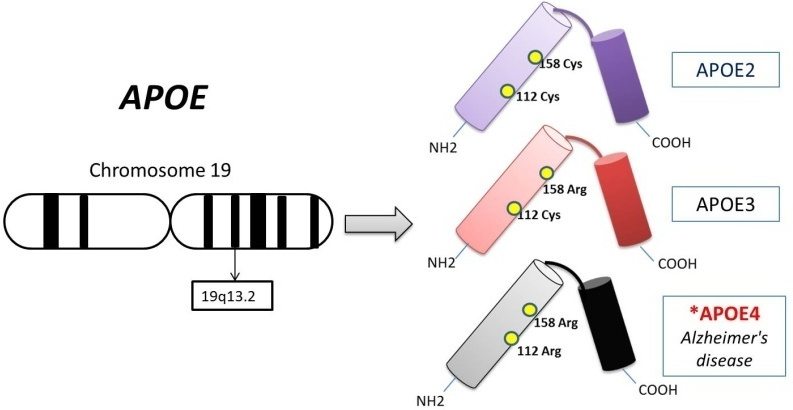 |
| *This is a diagram of the APOE gene. |
Ways to Slow the Progression
When someone is diagnosed with dementia, it changes their life and the lives of those who love them. There have been studies on finding some ways to delay the onset of developing Alzheimer's if you have been predestined to get it, as well as to slow the progression of this disease if you already have it. Some of the best techniques that have proven to be effective in slowing the progression of Alzheimer’s include: getting “a sufficient amount of sleep,” “[socializing],” “adopt[ing] a Mediterranean diet,” “[exercising],” “add[ing] unsaturated fats to your diet,” “perform[ing] puzzles,” and “read[ing] a book (Terra Vista).” All of these methods can help slow the process, but we need to find ways to slow the progression even more, and hopefully prevent it, so that people can have more time with their loved ones and be able to stay who they are a little while longer.
Funding
The problem with funding for this disease is not that there is no funding at all, but that there is very little funding going specifically towards research of the APOE4 gene and its link to dementia. There are many organizations that receive funding for their research on dementia, but not many people specialize in the APOE4 gene. If researchers can concentrate on the APOE4 gene specifically, we may get more progress on discovering why the APOE4 gene causes dementia, how to prevent it, and how to destroy it. Although we can now detect dementia earlier, we still have no way of preventing or stopping it. Congress should allocate their pursuits towards research on the APOE4 gene specifically, because as of yet we have not had any progress in being able to prevent or stop the onset of dementia and by narrowing it down to this specific gene, which causes the most common type of dementia in the world, we can focus more on one cause and possibly find how to stop this one gene. By stopping or slowing down, this one gene we can learn so much more about dementia as a whole and apply the findings from that research to other pursuits in the future.

*Forecast growth of dementia over the next 28 year
Conclusion
Dementia is a growing issue in our society today, and we must do something to stop it, because it will only get worse. Although we know so much more today about dementia than they did in Ancient Rome or Ancient China, we still suffer from this disease and have no idea how to stop it. According to the World Health Organization, the statistics show that by 2030 the numbers will rise to 78 million from 55 million people who have been diagnosed with dementia, so the time to act is now (Greenblat). I hope that this research paper informs Congress of the severity of this issue and that it will lead them to take action allowing scientists to further their research. If we learn more about APOE4 and dementia prevention, a source of deep heartache for those who have dementia and those who have loved ones with dementia can begin to heal by not only giving them hope, but a solution. In the end, my main goal is to make a difference in the lives of those who have suffered because of this terrible disease.
Works Cited
“Alzheimer's Disease Facts and Figures.” Alzheimer's Disease and Dementia, https://www.alz.org/alzheimers-dementia/facts-figures#:~:text=An%20estimated%206.5%20million%20Americans,older%20(10.7%25)%20has%20Alzheimer%27s.
APOE Gene. https://www.dietvsdisease.org/wp-content/uploads/2016/10/APOE-gene-alleles-variations.jpeg.
Assal, Frédéric. “History of Dementia.” Frontiers of Neurology and Neuroscience, U.S. National Library of Medicine, https://pubmed.ncbi.nlm.nih.gov/31220848/.
Bryant, Erin. “Study Reveals How APOE4 Gene May Increase Risk for Dementia.” National Institute on Aging, U.S. Department of Health and Human Services, https://www.nia.nih.gov/news/study-reveals-how-apoe4-gene-may-increase-risk-dementia#:~:text=APOE4%20is%20the%20strongest%20risk,lipid%20imbalances%20in%20brain%20cells.
Burton, Neel. “Plato and Aristotle on Health and Disease.” Psychology Today, Sussex Publishers, https://www.psychologytoday.com/us/blog/hide-and-seek/201203/plato-and-aristotle-health-and-disease.
“Cicero.” Britannica, https://cdn.britannica.com/58/181058-050-9CC9F60F/Marcus-Tullius-Cicero-detail-marble-bust-Capitoline.jpg.
Dacks, Penny. “What Apoe Means for Your Health.” Alzheimer's Drug Discovery Foundation, https://www.alzdiscovery.org/cognitive-vitality/blog/what-apoe-means-for-your-health.
Ellison, James M. “What Causes Dementia?” What Causes Dementia? | BrightFocus Foundation, https://www.brightfocus.org/alzheimers/article/what-causes-dementia?gclid=Cj0KCQjwqoibBhDUARIsAH2OpWhlK4VXgjH_qPJApX8Ubjw_4U7ePZT-s23M9inZDeLMSoOK3nf76A4aAn27EALw_wcB.
Greenblat, Cathy. “Dementia.” World Health Organization, World Health Organization, https://www.who.int/news-room/fact-sheets/detail/dementia#:~:text=Worldwide%2C%20around%2055%20million%20people,and%20139%20million%20in%202050.
khanacademymedicine. “Stages of Dementia and Alzheimer's Disease | Mental Health | Nclex-RN | Khan Academy.” YouTube, YouTube, 4 Sept. 2015, https://www.youtube.com/watch?v=K7dP25_Sebo.
Koriath, Carolin, et al. “APOE4 Lowers Age at Onset in Patients with Frontotemporal Dementia and Tauopathy Independent of Amyloid-β Copathology.” Alzheimer's & Dementia: Diagnosis, Assessment & Disease Monitoring, No Longer Published by Elsevier, 19 Mar. 2019, https://www.sciencedirect.com/science/article/pii/S2352872919300132.
MedlinePlus. “APOE Gene: Medlineplus Genetics.” MedlinePlus, U.S. National Library of Medicine, https://medlineplus.gov/genetics/gene/apoe/#conditions.
Roses, Allen D. “On the Discovery of the Genetic Association of Apolipoprotein e Genotypes and Common Late-Onset Alzheimer Disease.” Journal of Alzheimer's Disease : JAD, U.S. National Library of Medicine, https://pubmed.ncbi.nlm.nih.gov/16914873/.
Sibat, Humberto Foyaca, and Lourdes de Fátima Ibañez Valdés. “Introductory Chapter: Cognitive Disorders and Its Historical Background.” IntechOpen, IntechOpen, 5 Nov. 2018, https://www.intechopen.com/chapters/61421.
Terra Vista. “8 Ways to Slow the Progression of Alzheimer's Disease: Terra Vista.” Terra Vista of Oakbrook Terrace, 10 Dec. 2021, https://www.terravista.org/8-ways-to-slow-the-progression-of-alzheimers-disease/.
Vijayan, Murali, and P Hemachandra Reddy. “Stroke, Vascular Dementia, and Alzheimer's Disease: Molecular Links.” Journal of Alzheimer's Disease : JAD, U.S. National Library of Medicine, 6 Sept. 2016, https://www.ncbi.nlm.nih.gov/pmc/articles/PMC5793908/.
Walsh, Fergus. “Forecast Growth of Dementia Globally.” BBC, 20 July 2017, https://ichef.bbci.co.uk/news/976/cpsprodpb/15523/production/_97013378_dementia_gra_624.png.webp. Accessed 29 Nov. 2022.
“What Is Dementia?: National Institute on Aging.” Alzheimers.gov, https://www.alzheimers.gov/alzheimers-dementias/what-is-dementia.
Comments
Post a Comment